Saturday, February 25, 2012

Delicacy - A Review


French novelist and screenwriter Foenkinos tells the story of Natalie and Markus, two young coworkers traversing the uneasy terrain between love and friendship.

Natalie's life abruptly halts when her husband of seven years dies. With barely enough energy to continue on, Natalie returns to work but allows her friendships to lapse and her love life to disintegrate into nothingness. Enter Markus, a self-effacing Swede, who stumbles into her office at precisely the right moment. Taken over by the need to feel feminine, Natalie gives into a sudden and impulsive act that sends both her and Markus down a muddled path toward love. As with all stories of would-be-lovers, a number of obstacles are thrown in their way. Natalie and Markus must contend with their lovesick boss, Charles, and a horde of nosy coworkers who can't seem to understand Natalie's interest in the geeky Markus. The reader, unfortunately, will have to contend with the opposite problem as they are left to wonder what is so magnificent about Natalie. The fault lies with Foenkinos’s decision to present Natalie as a feminine ideal rather than a fully fleshed character. He tells the reader of Natalie’s love of reading, fascination with Pez dispensers, and educational background. None of these facts, however, make her personality any more decipherable as Foenkinos focuses more on her beauty than her character. Foenkinos's stylistic prose can also be faulted for this lack of character depth. This is unfortunate since his prose is also his greatest strength. The narrative style of Delicacy can best be described as ethereal ¾ concerned far more with style than substance. The reader sorts through pages and pages of aesthetically appealing prose without finding any true emotional connection to the characters. Hearts are broken and love restored, but the reader has difficulty caring. Foenkinos may believe that pretty words are an acceptable substitute for characters and story, but the reader may not be so convinced.

Delicacy is a meringue of a novel, and those wishing for meatier fiction should look elsewhere.

Thursday, February 16, 2012

My Neglected Classics

I started reading The Flight of Gemma Hardy earlier this week but found it boring.  Instead of forcing myself to finish it, I decided to sort through my bookshelves and find some books I've been meaning to read but haven't gotten around to picking up.  Now, I have a nice little pile of to-be-read books including Rebecca, A Tree Grows in Brooklyn, and Out of Africa.  At present, I'm reading Awakening by Kate Chopin, and I'm truly loving it.  I haven't read much literature since I graduated with my English degree, and I'm just now recalling how much I love reading the classics.  This is going to be the year I finally pick up all those George Eliot, Frances Burney, and John Galsworthy books I've been leaving to languish on my shelves.

Wednesday, February 15, 2012

First Person

Through junior high and most of high school, I refused to read first person narratives. I hated them with a passion because I had come across so many that were poorly executed. I now read first person narratives, and truth be told, some of my favorite are written in this way. I do, however, still come across quite a few that I can finish. Here are some of the reasons why:

Top Three First Person Narratives Pet Peeves:

1. There are multiple viewpoints, but everyone sounds the same. I have read so many books like this — men, women, and children of different backgrounds all sound the same. It is impossible and shows such a weakness on the writer’s part that I have to stop reading before I simply through the book across the room. If the narrator is first person, I like to be able to tell the identity of the viewpoint character just by their speech patterns and not by having their name at the top of the chapter. No two people sound exactly the same. If an author can’t write multiple viewpoints properly, she should write in third person and save themselves and the readers from consternation. (One book that defies this trap is The Help. The Help had three viewpoint characters and each had rich personal tones.)

2. Everyone sounds like a poet/professor of English Literature. Literary fiction writers should avoid first person at all costs. It doesn’t work as very few people other than literary fiction writers soliloquize in their heads. I can’t stand reading about children, soldiers, uneducated maids who speak in poetic narrative. It might be pretty, but its not believable. I have heard wonders upon wonders about The Shadow of the Wind. I wanted to like it, but I could not get past the fact that the narrator, who was a children, spoke to the reader like he was a professor of English. The book might have been wonderful, but I couldn’t get past that first person barrier to the good stuff.

3. Men sound like women, and women sound like men. Sometimes an author can successfully write a first person narrative for a character of the opposite sex. It does happen. Unfortunately, it too often fails miserably. If I begin a book not knowing the gender of the main character, I will make a guess based on their tone and syntax. There have been times, only when authors are writing as the opposite sex, that I have gotten it wrong. This was the case most recently with The Art of Civility. I was certain that the main character was a man for the first several pages, but then she began talking about her husband. I put down the book immediately, knowing that I wouldn’t be able to appreciate whatever story was to come because of that glaring distraction. The Maximum Ride books are also like this. I was sure Max was a boy for a really decent sized chunk of that first book. I really wish editors would notice this sort of thing and tell the writers to change narrative style. It would make everything so much less annoying for the rest of us.

Tuesday, February 14, 2012

Below Stairs - A Review

With the present success of the British television series Downton Abbey, St. Martin’s Press has re-released the classic memoir, Below Stairs. In Below Stairs, Margaret Powell recounts her career in domestic service and vividly recreates the world in which she lived.

As a child, Margaret Powell hoped to become a teacher, but her family was poor and there was no public assistance to pay for her education. Instead, she entered the workforce at the age of thirteen. For two years, she worked a series of odd jobs in her hometown of Hove, culminating in her dismissal from a laundry service for turning fifteen (the laundry wished to avoid giving her a half a crown raise). Her mother then decided it was time for her to enter domestic service. Margaret began her career with a position as a lowly kitchen maid but within three years, rose to the rank of cook through hard work and a bit of lying.

The joy I felt in reading Below Stairs had little to do with my fondness for Downton Abbey and much more to do with Margaret’s unique voice and the world she describes so clearly. Through her no-nonsense narration, we are transported back to the time between wars. Margaret introduces the reader to a post-World War I England in which everything has changed and yet many of its people are still reticent about moving forward. Many of Margaret’s employers were once something but are now forced to live on dwindling fortunes with only the good, old days to keep them company. Courtship no longer resembles that of Victorian England, and Margaret struggles to keep up as she searches for a husband. Women, in general, struggle to gain autonomy while society struggles with accepting them as independent, single women. Daily life now includes bicycling, car rides, cinema, and theater going. It’s a fascinating time, and Margaret allows the reader to experience it all through the eyes of a firsthand observer.

Throughout Below Stairs, Margaret guides us through her world with a straightforward and feisty voice. The reader becomes well acquainted with her and, by the last page, are reluctant to say good-bye to her and her world.

Monday, February 13, 2012

The Statistical Probability of Love at First Sight - A Review


Was it fate that lead Hadley to miss her plane to London by only four minutes or was it mere coincidence? In The Statistical Probability of Love at First Sight, Hadley considers such heavy material as fate, love, and marriage as she travels to London for her father's wedding and very possibly meets the boy of her dreams.

A series of mishaps leads Hadley to be late for her flight to London; this isn't terrible news for Hadley as she was dreading the trip to her father's wedding anyway. Unfortunately, she is able to get a seat on the next flight out -- one that will arrive just in time for her to be able to fulfill her bridesmaid duties. As she waits at the airport, she has a chance encounter with Oliver, a handsome, young Brit, who assists her with her luggage as she wanders through the airport. Oliver and Hadley strike up a conversation in the cafeteria that lasts through the entire flight to London. As they get to know each other, Hadley wonders if she and Oliver were meant to meet, and if so, does that mean they are meant to meet again?

Jennifer E. Smith's book is a lovely, little romantic comedy -- perfect for both teens and adults. The reader is immediately drawn into Hadley's drama as she frets over her father's remarriage and her sense of abandonment. We commiserate with her as she deals with her anxiety inducing claustrophobia, and we root for her to find hope and a little bit of happiness on her trip to London. When Oliver comes into her life, Hadley is given that gleam of hope, and it is enjoyable to watch as Oliver becomes a friend and confidant to Hadley just when she needs it most. From here, the story takes a fairly predictable path. And yes, we may have seen this all before in any number of romantic comedies, but that doesn't make it any less enjoyable here.

The characters in Smith's book are relatable and likeable, and the story is a perfect balance between sugary sweet comedy and emotional family drama. It is a fun, light read and highly recommended for anyone wishing to renew their belief in love and destiny.

Sunday, February 12, 2012

A Train in Winter - A Review

A Train in Winter tells the fascinating story of the French resistance during World War II. The author, Caroline Moorland, focuses her book on the women of the French resistance. These women might not wield guns or plant bombs, but they do house refugees in their hotels, print papers in their basements, and hand out flyers in the streets. These women chose to risk their lives rather than run to safety or simply endure. The women are grandmothers, mothers, daughters, and children, and all are drawn into the fight for different reasons. Some women fight for their children’s futures. Others fight for those who are being oppressed. Others still fight because they wish to continue the work of their arrested husbands, brothers, and fathers. A Train in Winter follows these women as they endure arrests at the hands of both the French and Nazis, torture and starvation in the death camps, and watching as all those they hold dear die around them.

Reading the introduction and book jacket, I expected something entirely different from A Train in Winter. I expected the author to focus more on the personal experiences of the women in the resistance and less on the overarching, historical events. Unfortunately, there are a minimum of fifty women mentioned in A Train in Winter, making it impossible for the reader to connect with any of the women. I would have much preferred Moorland to focus on several women rather than including everyone. The book would have been much better if she had alternated between chapters with background information and chapters with selections from her interviews. As it was, I couldn’t keep anyone straight and felt no connection to the women or their stories. The book lacked a sense of purpose and strength because of this excess of information. It became merely a dry, history book about an interesting topic, instead of the celebration of women and the friendships that kept them alive.

Saturday, February 11, 2012

Everneath - A Review

Brodi Ashton’s Everneath is a modern day retelling of the myth of Orpheus and Eurydice and the first book in a series centered around Persephone and her underworld kingdom.

This young adult novel tells the story of Nikki Beckett, a teenage girl with only six months left until she is forced to return to the underworld or Everneath, When the story opens, she is just waking up from a hundred year sleep in which an Everling, Cole, has absorbed her energy by stealing her emotions. Few survive this process and even fewer come through unscathed, but Nikki is special, making it through with some pieces of her personality in tack. While Cole wishes her to join him as an Everling, she chooses to return to the surface, hoping to rejoin her family and reunite with boyfriend, Jack. Although a hundred years has passed for her, only six months have passed for her family and friends. Six months, however, is long enough for everything to have changed. When she returns, her father is suspicious and angry, and her friends are emotionally scarred by her disappearance. Nikki hopes to spend her remaining time healing the hurts she caused by leaving and also in finding a way to avoid returning to the Everneath.

Everneath is a brilliant concept with its basis set firmly in the myths of Persephone and Eurydice. With the Everneath, Brodi Ashton creates a suitably scary and original underworld filled with ghostly sludge and hive-like caverns. Her concept of skimming emotions for energy appears to be an interesting new spin on the ever popular vampire genre. Overall, she successfully takes a popular myth and creates her own original spin on it. The difficulty with Everneath, however, does not lie in the concept or in Ashton’s world creation. Ashton creates a very vivid world but, unfortunately, chooses to populate it with flat characters. Our heroine, Nikki Beckett, has no personality, and the male leads, Cole and Jack, are uncomfortably abusive and domineering. Nikki has no hobbies or interests outside Jack and knitting. She does nothing to forward the story and instead, stops things dead by stalwartly refusing to do anything. She stands by while Jack and Cole battle over her and do all the legwork. These three characters have been seen in various incarnations since Twilight,but here they are at their most uninteresting to date.

Brodi Ashton tries but ultimately fails to make Everneath a truly compelling debut. Nikki Beckett’s dullness makes it impossible for this book to succeed; and since there are plenty of young adult novels with interesting heroines, I would recommend readers seek those out rather than looking for signs of life in Everneath.

(I have a sneaking suspicion that the author is a fan of Castle. Nikki Beckett? Maybe a combo of Nikki Heat and Kate Beckett? Hmmm … )

Friday, February 10, 2012

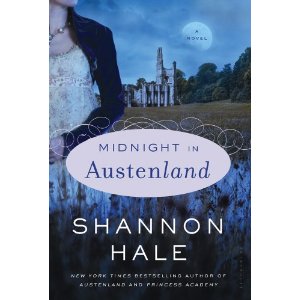
Midnight in Austenland - A Review

I find myself utterly perplexed as I consider Shannon Hale’s Midnight in Austenland. I really have no idea how to write a review for this book. No idea. There are just so many things wrong with it that I don’t even know where to begin. I mean I could start with how the author seems so astounded by her own cleverness that she feels she must include every (supposedly) witty line, even if its totally awkward and out of place in the narrative. I could also start with how the main character so little resembles a real person that I wanted the murderer to kill her just so I could spend more time with the more likeable, if not more realistic, characters.

Overall, this book was just so, soooo dumb. I didn’t expect it to be brilliant, but I did expect to enjoy it as a fluffy and fun read. This book was fluffy, but it was not fun. I wanted to fling it across the room by the end. Will you please tell me who stops to look at books when you are wandering around in a burned out building looking for a murderer? Who kisses a murderer just so he will not have the bad memory of trying to kill you (for the second time!!!) when he is in prison? And, most importantly, who would not have fun at Austenland? Why are all Shannon Hale’s heroines so unhappy there? This is the place most Janeites would call the happiest place on earth! I know I would. I disliked her from the beginning because she was all nervous and snarky about Austenland. I’m like, come on! Its like being on Regency House Party! What wouldn’t be fun about that?

Basically, if you are a Jane Austen fan, I recommend reading something else (anything else), because why would you want to waste your time reading a book in which circumstances force the heroine to utter: “It needs to be said that we’re not really brother and sister”?

Thursday, February 9, 2012

The River (Pilot) Review


The pilot of the River is the most successful pilot I have seen this 2011/2012 season. In my opinion, a successful pilot must introduce characters, set up avenues for potential drama between them, set up the tone of the show, and create a blue print for the rest of the series. A successful pilot must also avoid heavy handed expository dialogue, contrived cliques, excess of confusing plot twists, and unnecessary backstory/information. Pilots are insanely difficult to write, and it definitely shows. Several months back, I made a study of the pilots from a variety of shows (we’re talking shows like Buffy, Dollhouse, Supernatural, X-files, and Fringe). At the end of my little study, the most successful pilot I watched was X-files. Chris Carter did an amazing job setting up his show. The pilot was basically a microcosm for what we would be seeing every week and throughout the entire run of the show. There are very few writers who can create a decent opener for their show, and the River has joined the ranks of rare exceptions.

The basic plot of the River is this: Emmett Cole (a cross between Steve Irwin and Marty Stouffer) has disappeared in the Amazon, and his wife, son, and documentary crew set off in search of him. These unfortunate few are lead into the deep, dark heart of the Amazon river and it is there they find things that defy explanation. I know what you’re thinking. The story is vaguely reminiscent of Lost, but you shouldn’t waste too much time comparing these two shows. While J. J. Abrams’ train wreck was all about uncovering the truth of the Island, the River appears to be more about the journey to the Source and not so much what is found there. I do not expect to receive all the answers here like I did in Lost. We are dealing with magic and the supernatural in the River, and I expect terror and awe more than an understanding of the mysteries of the universe. We cannot expect these sojourners to find the truth, but we can expect to enjoy joining them on their journey into the darkness.

The pilot was so brilliant that I wanted to give the show a round of applause before the first five minutes were up. I was just blown away by the brilliant use of “backfootage.” The documentary style could have held the show back, but the clips shown from Emmett Cole’s documentaries make it possible for this show to have a depth that I hadn’t expected. And the show did have depth. We are not dealing only with endless scares and a fast moving plot. We have characters who hate each other, love each other, and have all sorts of complicated reasons for coming along on this journey. These individuals are not merely the writer’s pawns but are characters who move the story along with their own increasingly unique personalities. I look forward to getting to know each of them better and further understanding why they have come to this place.

The River is billed as a scary show, but its not hide-your-face-under-the-covers frightening. Basically, the show is scary without being nightmare inducing. The doll tree in Part Two was especially creepy, and I just loved waiting with bated breath for the doll’s head to turn or eyes to close. If you’re used to scarier stuff than, say, Supernatural, this will be pretty light weight for you. If, however, you easily jump out of your seat, you might find this show as terrifying as the writers seem to hope.

Finally, in case you watch the River and wonder why the cast looks so familiar, it is probably because they have all been in a lot of different shows over the years. You have Terri from 24, Whistler from Prison Break, Kirk’s captain from the new Star Trek, that dude from Across the Universe, Harry from Dresden Files, and that one guy from Doctor Who’s Season Two drilling episodes. Everyone on this show seemed decently cast (with the exception of Terri who seemed much too young to be her son’s mother), and I look forward to getting to know all of their characters better as the show moves along.

Overall, The River is not subtle or a work of art, but it is fun and I hope it continues to be successful as its pilot. I definitely recommend giving it a chance.

Warning: The documentary style can be disorienting but the truly shaky camera moments are few and far between.

Monday, December 26, 2011

And the result is. . .

Your result for The Jane Austen heroine Test ...

Fanny Price

52% romance, 45% sauciness, 44% etiquette, 82% intelligence
Fanny Price
Still waters run deep. You've got plenty of intelligence and more heart than you get credit for. But you never say a word when insulted, and this reticence sometimes allows others to assume you're a pushover. You're also a bit shy in mixed company, which leads those who don't know you well to accuse you of snobbery. They couldn't be more wrong! You just never seem to know what to say. Of course, the meek shall inherit the earth...eventually. But do you really want to wait that long for redemption? Ideal matches: Edmund Bertram, Edward Ferrars, Captain Benwick, Colonel Brandon Guaranteed heartbreak: Frank Churchill, John Thorpe Not worthy of your affections: Henry Crawford, John Willoughby
 
I always knew I was a Fanny Price.  Its okay.  I'm not offended.  Mansfield Park is my favorite Jane Austen novel.  I know its probably everyone elses least favorite (with the exception maybe of Northanger Abbey), but I love its intelligence.  And hey, the above description is pretty spot on.    
 

Monday, December 19, 2011

Season to Taste - A Review

An aspiring chef's moving account of finding her way—in the kitchen and beyond—after a tragic accident destroys her sense of smell

At twenty-two, just out of college, Molly Birnbaum spent her nights reading cookbooks and her days working at a Boston bistro, preparing to start training at the prestigious Culinary Institute of America. She knew exactly where she wanted the life ahead to lead: She wanted to be a chef. But shortly before she was due to matriculate, she was hit by a car while out for a run in Boston. The accident fractured her skull, broke her pelvis, tore her knee to shreds—and destroyed her sense of smell. The flesh and bones would heal...but her sense of smell? And not being able to smell meant not being able to cook. She dropped her cooking school plans, quit her restaurant job, and sank into a depression.

Season to Taste is the story of what came next: how she picked herself up and set off on a grand, entertaining quest in the hopes of learning to smell again. Writing with the good cheer and great charm of Laurie Colwin or Ruth Reichl, she explores the science of olfaction, pheromones, and Proust's madeleine; she meets leading experts, including the writer Oliver Sacks, scientist Stuart Firestein, and perfumer Christophe Laudamiel; and she visits a pioneering New Jersey flavor lab, eats at Grant Achatz's legendary Chicago restaurant Alinea, and enrolls at a renowned perfume school in the South of France, all in an effort to understand and overcome her condition.

A moving personal story packed with surprising facts about our senses, Season to Taste is filled with unforgettable descriptions of the smells Birnbaum rediscovers—from cinnamon, cedarwood, and fresh bagels to rosemary chicken, lavender, and apple pie—as she falls in love, learns to smell from scratch, and starts, once again, to cook.  ~ From Goodreads

Season to Taste is a semi-interesting memoir about one young woman's journey to come to terms with the impairment of her sense of smell.  The book is at its best when describing food with luscious adjectives, but too often it gets bogged down with the author's inability to structure her thoughts. 

Season to Taste constantly jumps back and forth between Molly Birnbaum's everyday struggles with regaining her sense of smell and the science behind how the brain processes scent.  I found the author to be slightly annoying, mainly for her inability to stay on topic.  I never got over this annoyance because she really never gave the reader time to know her.  Instead, any time the reader gets close, she begins spouting off more facts and figures.  Interviews popped up at random times, jarring the reader out of the narrative.  Overall, the book was just oddly paced and structured.  I would have liked it much better if she had separated her personal life into different chapters from her interviews and research.  The timeline is all over the place and indiscerible since everything is just meshed together.  I wished she had spent more time recounting the stories of others who had lost their ability to smell.  I found their stories to have much more flavor and emotional impact than her own.

I would only recommend this book to people who either have a condition similar to her own or are  interested in the science of scent.  Molly Birnbaum did bring attention to the much overlooked issue of loss of smell, and for that, she should be applauded.  I only wish her book would have been written a bit better so it could have packed a harder punch. 

I give this book two stars. 

Friday, December 16, 2011

The Fellowship of the Ring


The 19th of December will mark the 10th anniversary of the release of The Fellowship of the Ring in theaters.  Back when it was released, I was a thirteen year old on the cusp of becoming a full fledged geek.  I had read children's fantasy for several years but experiencing Lord of the Rings, both movies and books, marked my irrevocable entrance into geekdom. 

I saw that first movie five times in the theater - each time with a different set of people.  I saw it first with my parents for my dad's birthday.   I remember the sort of breathless excitement I had going in that first time.  I wanted so much to know what it was going to be like, but, at the same time, I dreaded it.  I wondered who would play Pippin?  Would they include Tom Bombadil?  Would they change everything?   Would it be awful?  I waited as the trailers played through and the haunting music began.  Then that breathy prologue started began, and I knew I wasn't going to be disappointed.  I loved that movie from beginning to end, and I'll never forget the euphoric feeling of experiencing that movie for the first time.       

After watching LOTR, I began chain reading other epic fantasy series like Robert Jordan's Wheel of Time and Terry Brooks' Sword of Shannara series.    I fell in love with other fantasy movies like Willow and Ladyhawke.  I talked incessantly about hobbits and followed the actors online.  My cousin and I wrote slash laden stories for each other and made Pippiny cards and shirts for all occasions.  I wrote quiz books and made unfortunately long LOTR inspired skits at youth group movie nights.  I waited with baited breath for the next movie to come out and then the next.      

It was such a fun time to be introduced to the fantasy genre.  I was able to see LOTR in the theater and collect all the fun, geeky toys and game as they were released.  I was able to watch award shows and root on writers, directors, and films for the first time.  I could talk to all sorts of people about the stories and the characters and the actors.  I really was able to feel a sense of community over these books and movies which is something I've only ever experienced since with Harry Potter.  

I will always cherish my time as an unabashed LOTR fan.  I might not love the movies as much as I used to or EVER plan to read the books again, but this series introduced me to fantasy and to a community of really interesting and enthusiastic people.  And for that, I will always be thankful.  

Wednesday, December 14, 2011

The Girl Who Circumnavigated Fairyland in a Ship of Her Own Making - A Review

Twelve-year-old September lives in Omaha, and used to have an ordinary life, until her father went to war and her mother went to work. One day, September is met at her kitchen window by a Green Wind (taking the form of a gentleman in a green jacket), who invites her on an adventure, implying that her help is needed in Fairyland. The new Marquess is unpredictable and fickle, and also not much older than September. Only September can retrieve a talisman the Marquess wants from the enchanted woods, and if she doesn’t . . . then the Marquess will make life impossible for the inhabitants of Fairyland. September is already making new friends, including a book-loving Wyvern and a mysterious boy named Saturday.   ~ From Goodreads
Catherynne M. Valente's novel is absolutely wonderful.  It has the same wild creativity as a Neil Gaiman novels mixed with the knowing wisdom of Terry Pratchett's work.  Valente does not shy away from uncomfortable truths like C. S. Lewis did in The Lion, the Witch, and the Wardrobe, but rather faces them full on, making her story completely different than all its predecessors.  

I fell in love with this book from the first page and surprised myself by loving it all the way through.  So often children's novels of this sort lag at the halfway point (The Graveyard Book for instance) but Valente's story kept its pace from beginning to end.  I completely lost in Fairyland along with September, and I was a bit disappointed to find my way again with the closing of the last page. 

Chapter XVI (Until We Stop) is by far my favorite part of the entire book.   The fishing scene is gruesome, heart wrenching, and overall just plain truthful in its depiction of September's reaction to killing the fish.  If I had to do what September did, I would be bawling my eyes out too.  I love that  Valente shows real emotion and loss.  I've always held C. S. Lewis at fault for not depicting the repercussions of the Pevensie children's adventures.   After all those children went through, they should have PTSD.  Valente, however, does not shy away from exposing her characters to lasting pain.  Blood is drawn.  Bones are broken.   Loss is real.  

The Girl Who Circumnavigated Fairyland in a Ship of Her Own Making is not treading new ground, but it really isn't trying to.  Valente gives nods to Wizard of Oz, Alice in Wonderland,  and Chronicles of Narnia throughout her story, and really this book has everything you loved about those old classics and so much more.  Its a fairy tale for adults as well as children.  And aren't those really the best kind?     

Tuesday, December 13, 2011

Practical Magic - A Review

At 11:00pm last night, I became extremely peeved when my copy of Practical Magic abruptly ended at page 260 in the middle of a sentence.   I had been trying to read through the last two sections before going to bed.  Unfortunately, I was brought to a halt twenty pages short of the conclusion.  This morning, I had to rush out to the library to pick up another copy so I could know how it all ended.  

First, let me say that I loved this book.  And I mean LOVED.  As soon as I read the first sentence, I knew it would be one of those rare books that I could just lose myself in from beginning to end.  This rarely happens for me, and so its absolutely heavenly whenever I find a book that I connect to in this way.   Alice Hoffman has a way of making you feel like you're being buoyed in warm bath as you read her novels.  This isn't to say her books are what most people would consider comfy cozy.  I'm probably unusual in that my comfort reading tends to include death, heartbreak, and desire.  I don't like happy books and so Hoffman's more realistic (albeit magical) stories appeal to me.  

In Practical Magic, I loved that the story focused on the relationships between women.  Its rare to find a book that feels truthful in its depiction of what women are really like.   Alice Hoffman is gifted in being able to reflect the complexity of these relationships with such understated ease.  Of course, everything Alice Hoffman does is understated.  I am sick to death of books that bang you over the head with all their themes and romances and complicated relationships.  It is so refreshing to find an author who just gives you an interpretation of life and allows you to glean from it what you may.

This is only the third book I've read by Alice Hoffman, but I'm already looking forward to my next.  She's becoming one of my favorite, authors and for me this is exhilarating since I rarely like any author well enough to read more than one of their books. 

I would recommend this book to anyone who loves stories stories about strong women, magic, and the worth of true love.

I give it five stars.

Wednesday, September 7, 2011

Whedon Withdraw

Review: A Wedding in December


 In Anita Shreve's ensemble novel, seven former high school friends reunite for a wedding in the Berkshires, 26 years after their graduation. This Big Chill–like gathering stirs old passions and feuds, some of which have been festering since the death of a charismatic schoolmate at a high school party. As usual, Shreve puts her characters through the emotional wringer before she sets them out to dry. Wedding in December is one of her most effective and moving works.  ~ From Goodreads

I enjoyed the concept of high school friends reuniting after twenty-seven years, but the way the author carried out the concept left something to be desired.  The book was at its best when the characters were interacting with each other.  I enjoyed the scenes between Harrison and Nora.  I would have been quite happy if the entire story was just about them.  The story, however, included a large cast of characters, many of whom didn't get the page space they deserved. 

Unfortunately, the author chose to cut back on the interactions between characters and include letters and Anges' story.  I was especially annoyed by the number of pages wasted on the story.  I wanted to skim past it, but I wasn't sure if it was important so I kept slogging through it.  In the end, I think the story should have been cut or severely shortened.  Its inclusion was distracting and clunky. 

This book could have been very good, but in the end, its just okay.  This is the first book I read by Anita Shrieve.  I would be willing to read more of her books, but I don't think this one is rereadable.

Saturday, July 16, 2011

Randomness. . .

Its Saturday, and I thought I'd just share with you a music video for today.  Enjoy!

Friday, July 15, 2011

Fall Television

So there's just two months until the Fall TV season starts up, and I'm telling you, I'm anxious for it to begin. Summer Television is less than enthralling when you don't have cable. I've been watching stuck watching the Bachelorette and reruns of Gossip Girl. Not exceptionally pleasant. At least, this fall promises to have some good shows going for it. There will be the return of my personal favorites: Supernatural and Vampire Diaries. Both shows ended with cliffhangers and I'm going to be very interested in what the next season brings for my favorite hunters and vampires.

I'm more excited, however, about the new shows turning up on all the channels. Last season had less than stellar new shows, so I'm still going into this season realistic and yet hopeful. For the fall, I'm most excited about Terra Nova - the show that has dinosaurs, time travel, and Steven Spielberg all rolled into one. Terra Nova could either be really, really great or really, really awful. The budget for the show is enormous, so the audience is going to have to be a pretty decent size to keep this show on the air. I have high hopes, but that's mainly just because I love anything with dinosaurs in it. Yes, this sadly includes Primeval.

Another show I'm interested in is the Ringer. I loved Buffy and am excited to see Sarah Michelle Gellar in a new show. Also, the show has Ioan Gruffudd. I've been a fan of that man since I first saw Horatio Hornblower when I was in high school. I hope his first foray into American TV turns out well for him. A bit of history, the show was passed over by CBS and then picked up by the CW for the Fall season. I'm still not sure how to take this. You see . . . I loath CBS. Their shows tend to be awful and overly dramatic. If the Ringer isn't like other CBS shows, this is good news to me. I'm hoping that CBS overlooked the show because it wasn't their style rather than because it wasn't that good. I look forward to having yet another awesome CW show to watch.


Finally, I'm intrigued by Person of Interest. This is a CBS show, but I'm going to try and watch with an open mind. Alright, the open mind thing is actually going to be really hard because the show is produced by J.J. Abrams. I used to love J.J., but now, I'm a bit disillusioned. I loved Super 8, but that hardly makes up for the awful ending of Lost or the badness of Fringe. I don't trust him when it comes to shows. There are two reasons, however, that make me willing to overlook all of this. The first is Michael Emerson. Ben from Lost is one of my favorite characters ever. I think Michael Emerson was brilliant in that role, and I can't wait to see what he chooses to do next. The second reason is that Jonathan Nolan is one of the producers. Jonathan Nolan is the little brother of Christopher and the writer of the Dark Knight and Prestige. I love the Nolan brothers and want to see what he's up to with this show. I trust him about as much as I distrust J.J. Oh yeah, and I forgot to say what this show is about. Imdb.com describes the show as centering on an ex-CIA hitman and a scientist who team up to prevent crimes before they happen. Could be interesting. Could be lame. We'll just have to wait and see.
All I say say is this: Fall 2011 is going to make for some interesting television watching.

Thursday, July 14, 2011

The Young Visiters


Today, in honor of David Yates' final Harry Potter film, I decided to watch an earlier work of his: The Young Visiters.  (And yes, I do mean visiters and not visitors.)  The film is based on a book written by Daisy Ashford in 1890.  The important thing to understand is that Daisy Ashford was nine years old when she wrote this masterpiece.  (This is why the title is spelled incorrectly and also why the movie might feel a bit trippy and over the top at times.)  I have yet to read the book, but I understand it is very unintentionially amusing.  The movie, however, is intentionally amusing as it recreates this nine year old's vision of Victorian England.

The story:  Forty-two year old Alfred Salteena meets the young and pretty Ethel on a train ride.  He falls instantly in love with her and makes the rash promise to help her meet lords and dukes and royalty so that he might be able to spend more time with her.  Everything is going along splendidly until she is introduced to Lord Clark.  Lord Clark falls for her, and she falls for his title.  Mr. Salteena decides that he must gain a title to win her love, and he goes off the the Crystal Palace where he is taught to be a gentleman. 

The story is underwhelming in and of itself.  The fun of this movie comes from the cast and from Daisy Ashford's entertaining view of her society.  I don't want to give away the craziness that is Daisy Ashford's world, so I"ll just focus briefly on the actors.   Mr. Salteena is played by Jim Broadbent (Moulin Rouge),  Ethel by Lyndsey Marshall (Garrow's Law), and Lord Clark by Hugh Laurie (House).  Okay, truth be told, I'm just going to focus on one actor.  Hugh Laurie.  Now, I love Hugh Laurie in whatever he is in, but I absolutely adored him in this.  He is very understated here compared to some of the other actors, but his expressions are priceless.  My favorite scenes were the proposal scene and the scene at the hotel.  I was laughing through both of them, mostly because Hugh Laurie just appears so overwhelmed by Ethel's enthusiam.  This movie is worth watching just for Hugh Laurie.   If you are a fan of his at all, you must see this.

Overall, this film is very cute and funny.  I enjoyed catching random glimpses of Bill Nighy (I Capture the Castle and He Knew He was Right), Sally Hawkins (Persuasion), and Sophie Thompson (Emma and Gosford Park).  I also enjoyed the inappropriate dance scenes and Ethel's costumes (her dresses were unusual, but strangely pretty.  I could picture Helena Bohnam Carter in them all, if that tells you anything).  I fully recommend checking this out, if you can find it.  Just remember, this was actually written by a nine year old.  The narrator is NOT playing with you. 

In conclusion, here is one of my favorite scenes.  Spoilers beware!

Friday, June 17, 2011

Tolstoy and the Purple Chair - Quick Review


An interesting memior concerning a woman working through her grief over her sister's death.  I enjoyed sharing the author's journey, but sometimes the stories felt a bit repetitive, and later the chapters were a bit vague as to their purpose within the scope of the memior.  The stories felt at times like they would have been better served as individual essays, rather than chapters in a book.  I, personally, would recommend The Reading Promise over this book.  They are similar, but The Reading Promise is much stronger and less indulgent.