Showing posts with label books. Show all posts

Saturday, February 25, 2012

Delicacy - A Review


French novelist and screenwriter Foenkinos tells the story of Natalie and Markus, two young coworkers traversing the uneasy terrain between love and friendship.

Natalie's life abruptly halts when her husband of seven years dies. With barely enough energy to continue on, Natalie returns to work but allows her friendships to lapse and her love life to disintegrate into nothingness. Enter Markus, a self-effacing Swede, who stumbles into her office at precisely the right moment. Taken over by the need to feel feminine, Natalie gives into a sudden and impulsive act that sends both her and Markus down a muddled path toward love. As with all stories of would-be-lovers, a number of obstacles are thrown in their way. Natalie and Markus must contend with their lovesick boss, Charles, and a horde of nosy coworkers who can't seem to understand Natalie's interest in the geeky Markus. The reader, unfortunately, will have to contend with the opposite problem as they are left to wonder what is so magnificent about Natalie. The fault lies with Foenkinos’s decision to present Natalie as a feminine ideal rather than a fully fleshed character. He tells the reader of Natalie’s love of reading, fascination with Pez dispensers, and educational background. None of these facts, however, make her personality any more decipherable as Foenkinos focuses more on her beauty than her character. Foenkinos's stylistic prose can also be faulted for this lack of character depth. This is unfortunate since his prose is also his greatest strength. The narrative style of Delicacy can best be described as ethereal ¾ concerned far more with style than substance. The reader sorts through pages and pages of aesthetically appealing prose without finding any true emotional connection to the characters. Hearts are broken and love restored, but the reader has difficulty caring. Foenkinos may believe that pretty words are an acceptable substitute for characters and story, but the reader may not be so convinced.

Delicacy is a meringue of a novel, and those wishing for meatier fiction should look elsewhere.

Wednesday, February 15, 2012

First Person

Through junior high and most of high school, I refused to read first person narratives. I hated them with a passion because I had come across so many that were poorly executed. I now read first person narratives, and truth be told, some of my favorite are written in this way. I do, however, still come across quite a few that I can finish. Here are some of the reasons why:

Top Three First Person Narratives Pet Peeves:

1. There are multiple viewpoints, but everyone sounds the same. I have read so many books like this — men, women, and children of different backgrounds all sound the same. It is impossible and shows such a weakness on the writer’s part that I have to stop reading before I simply through the book across the room. If the narrator is first person, I like to be able to tell the identity of the viewpoint character just by their speech patterns and not by having their name at the top of the chapter. No two people sound exactly the same. If an author can’t write multiple viewpoints properly, she should write in third person and save themselves and the readers from consternation. (One book that defies this trap is The Help. The Help had three viewpoint characters and each had rich personal tones.)

2. Everyone sounds like a poet/professor of English Literature. Literary fiction writers should avoid first person at all costs. It doesn’t work as very few people other than literary fiction writers soliloquize in their heads. I can’t stand reading about children, soldiers, uneducated maids who speak in poetic narrative. It might be pretty, but its not believable. I have heard wonders upon wonders about The Shadow of the Wind. I wanted to like it, but I could not get past the fact that the narrator, who was a children, spoke to the reader like he was a professor of English. The book might have been wonderful, but I couldn’t get past that first person barrier to the good stuff.

3. Men sound like women, and women sound like men. Sometimes an author can successfully write a first person narrative for a character of the opposite sex. It does happen. Unfortunately, it too often fails miserably. If I begin a book not knowing the gender of the main character, I will make a guess based on their tone and syntax. There have been times, only when authors are writing as the opposite sex, that I have gotten it wrong. This was the case most recently with The Art of Civility. I was certain that the main character was a man for the first several pages, but then she began talking about her husband. I put down the book immediately, knowing that I wouldn’t be able to appreciate whatever story was to come because of that glaring distraction. The Maximum Ride books are also like this. I was sure Max was a boy for a really decent sized chunk of that first book. I really wish editors would notice this sort of thing and tell the writers to change narrative style. It would make everything so much less annoying for the rest of us.

Tuesday, February 14, 2012

Below Stairs - A Review

With the present success of the British television series Downton Abbey, St. Martin’s Press has re-released the classic memoir, Below Stairs. In Below Stairs, Margaret Powell recounts her career in domestic service and vividly recreates the world in which she lived.

As a child, Margaret Powell hoped to become a teacher, but her family was poor and there was no public assistance to pay for her education. Instead, she entered the workforce at the age of thirteen. For two years, she worked a series of odd jobs in her hometown of Hove, culminating in her dismissal from a laundry service for turning fifteen (the laundry wished to avoid giving her a half a crown raise). Her mother then decided it was time for her to enter domestic service. Margaret began her career with a position as a lowly kitchen maid but within three years, rose to the rank of cook through hard work and a bit of lying.

The joy I felt in reading Below Stairs had little to do with my fondness for Downton Abbey and much more to do with Margaret’s unique voice and the world she describes so clearly. Through her no-nonsense narration, we are transported back to the time between wars. Margaret introduces the reader to a post-World War I England in which everything has changed and yet many of its people are still reticent about moving forward. Many of Margaret’s employers were once something but are now forced to live on dwindling fortunes with only the good, old days to keep them company. Courtship no longer resembles that of Victorian England, and Margaret struggles to keep up as she searches for a husband. Women, in general, struggle to gain autonomy while society struggles with accepting them as independent, single women. Daily life now includes bicycling, car rides, cinema, and theater going. It’s a fascinating time, and Margaret allows the reader to experience it all through the eyes of a firsthand observer.

Throughout Below Stairs, Margaret guides us through her world with a straightforward and feisty voice. The reader becomes well acquainted with her and, by the last page, are reluctant to say good-bye to her and her world.

Sunday, February 12, 2012

A Train in Winter - A Review

A Train in Winter tells the fascinating story of the French resistance during World War II. The author, Caroline Moorland, focuses her book on the women of the French resistance. These women might not wield guns or plant bombs, but they do house refugees in their hotels, print papers in their basements, and hand out flyers in the streets. These women chose to risk their lives rather than run to safety or simply endure. The women are grandmothers, mothers, daughters, and children, and all are drawn into the fight for different reasons. Some women fight for their children’s futures. Others fight for those who are being oppressed. Others still fight because they wish to continue the work of their arrested husbands, brothers, and fathers. A Train in Winter follows these women as they endure arrests at the hands of both the French and Nazis, torture and starvation in the death camps, and watching as all those they hold dear die around them.

Reading the introduction and book jacket, I expected something entirely different from A Train in Winter. I expected the author to focus more on the personal experiences of the women in the resistance and less on the overarching, historical events. Unfortunately, there are a minimum of fifty women mentioned in A Train in Winter, making it impossible for the reader to connect with any of the women. I would have much preferred Moorland to focus on several women rather than including everyone. The book would have been much better if she had alternated between chapters with background information and chapters with selections from her interviews. As it was, I couldn’t keep anyone straight and felt no connection to the women or their stories. The book lacked a sense of purpose and strength because of this excess of information. It became merely a dry, history book about an interesting topic, instead of the celebration of women and the friendships that kept them alive.

Saturday, February 11, 2012

Everneath - A Review

Brodi Ashton’s Everneath is a modern day retelling of the myth of Orpheus and Eurydice and the first book in a series centered around Persephone and her underworld kingdom.

This young adult novel tells the story of Nikki Beckett, a teenage girl with only six months left until she is forced to return to the underworld or Everneath, When the story opens, she is just waking up from a hundred year sleep in which an Everling, Cole, has absorbed her energy by stealing her emotions. Few survive this process and even fewer come through unscathed, but Nikki is special, making it through with some pieces of her personality in tack. While Cole wishes her to join him as an Everling, she chooses to return to the surface, hoping to rejoin her family and reunite with boyfriend, Jack. Although a hundred years has passed for her, only six months have passed for her family and friends. Six months, however, is long enough for everything to have changed. When she returns, her father is suspicious and angry, and her friends are emotionally scarred by her disappearance. Nikki hopes to spend her remaining time healing the hurts she caused by leaving and also in finding a way to avoid returning to the Everneath.

Everneath is a brilliant concept with its basis set firmly in the myths of Persephone and Eurydice. With the Everneath, Brodi Ashton creates a suitably scary and original underworld filled with ghostly sludge and hive-like caverns. Her concept of skimming emotions for energy appears to be an interesting new spin on the ever popular vampire genre. Overall, she successfully takes a popular myth and creates her own original spin on it. The difficulty with Everneath, however, does not lie in the concept or in Ashton’s world creation. Ashton creates a very vivid world but, unfortunately, chooses to populate it with flat characters. Our heroine, Nikki Beckett, has no personality, and the male leads, Cole and Jack, are uncomfortably abusive and domineering. Nikki has no hobbies or interests outside Jack and knitting. She does nothing to forward the story and instead, stops things dead by stalwartly refusing to do anything. She stands by while Jack and Cole battle over her and do all the legwork. These three characters have been seen in various incarnations since Twilight,but here they are at their most uninteresting to date.

Brodi Ashton tries but ultimately fails to make Everneath a truly compelling debut. Nikki Beckett’s dullness makes it impossible for this book to succeed; and since there are plenty of young adult novels with interesting heroines, I would recommend readers seek those out rather than looking for signs of life in Everneath.

(I have a sneaking suspicion that the author is a fan of Castle. Nikki Beckett? Maybe a combo of Nikki Heat and Kate Beckett? Hmmm … )

Friday, February 10, 2012

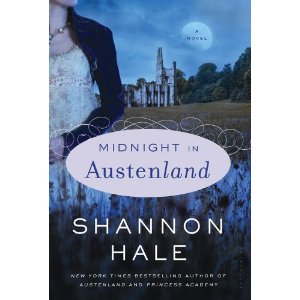
Midnight in Austenland - A Review

I find myself utterly perplexed as I consider Shannon Hale’s Midnight in Austenland. I really have no idea how to write a review for this book. No idea. There are just so many things wrong with it that I don’t even know where to begin. I mean I could start with how the author seems so astounded by her own cleverness that she feels she must include every (supposedly) witty line, even if its totally awkward and out of place in the narrative. I could also start with how the main character so little resembles a real person that I wanted the murderer to kill her just so I could spend more time with the more likeable, if not more realistic, characters.

Overall, this book was just so, soooo dumb. I didn’t expect it to be brilliant, but I did expect to enjoy it as a fluffy and fun read. This book was fluffy, but it was not fun. I wanted to fling it across the room by the end. Will you please tell me who stops to look at books when you are wandering around in a burned out building looking for a murderer? Who kisses a murderer just so he will not have the bad memory of trying to kill you (for the second time!!!) when he is in prison? And, most importantly, who would not have fun at Austenland? Why are all Shannon Hale’s heroines so unhappy there? This is the place most Janeites would call the happiest place on earth! I know I would. I disliked her from the beginning because she was all nervous and snarky about Austenland. I’m like, come on! Its like being on Regency House Party! What wouldn’t be fun about that?

Basically, if you are a Jane Austen fan, I recommend reading something else (anything else), because why would you want to waste your time reading a book in which circumstances force the heroine to utter: “It needs to be said that we’re not really brother and sister”?

Monday, December 19, 2011

Season to Taste - A Review

An aspiring chef's moving account of finding her way—in the kitchen and beyond—after a tragic accident destroys her sense of smell

At twenty-two, just out of college, Molly Birnbaum spent her nights reading cookbooks and her days working at a Boston bistro, preparing to start training at the prestigious Culinary Institute of America. She knew exactly where she wanted the life ahead to lead: She wanted to be a chef. But shortly before she was due to matriculate, she was hit by a car while out for a run in Boston. The accident fractured her skull, broke her pelvis, tore her knee to shreds—and destroyed her sense of smell. The flesh and bones would heal...but her sense of smell? And not being able to smell meant not being able to cook. She dropped her cooking school plans, quit her restaurant job, and sank into a depression.

Season to Taste is the story of what came next: how she picked herself up and set off on a grand, entertaining quest in the hopes of learning to smell again. Writing with the good cheer and great charm of Laurie Colwin or Ruth Reichl, she explores the science of olfaction, pheromones, and Proust's madeleine; she meets leading experts, including the writer Oliver Sacks, scientist Stuart Firestein, and perfumer Christophe Laudamiel; and she visits a pioneering New Jersey flavor lab, eats at Grant Achatz's legendary Chicago restaurant Alinea, and enrolls at a renowned perfume school in the South of France, all in an effort to understand and overcome her condition.

A moving personal story packed with surprising facts about our senses, Season to Taste is filled with unforgettable descriptions of the smells Birnbaum rediscovers—from cinnamon, cedarwood, and fresh bagels to rosemary chicken, lavender, and apple pie—as she falls in love, learns to smell from scratch, and starts, once again, to cook.  ~ From Goodreads

Season to Taste is a semi-interesting memoir about one young woman's journey to come to terms with the impairment of her sense of smell.  The book is at its best when describing food with luscious adjectives, but too often it gets bogged down with the author's inability to structure her thoughts. 

Season to Taste constantly jumps back and forth between Molly Birnbaum's everyday struggles with regaining her sense of smell and the science behind how the brain processes scent.  I found the author to be slightly annoying, mainly for her inability to stay on topic.  I never got over this annoyance because she really never gave the reader time to know her.  Instead, any time the reader gets close, she begins spouting off more facts and figures.  Interviews popped up at random times, jarring the reader out of the narrative.  Overall, the book was just oddly paced and structured.  I would have liked it much better if she had separated her personal life into different chapters from her interviews and research.  The timeline is all over the place and indiscerible since everything is just meshed together.  I wished she had spent more time recounting the stories of others who had lost their ability to smell.  I found their stories to have much more flavor and emotional impact than her own.

I would only recommend this book to people who either have a condition similar to her own or are  interested in the science of scent.  Molly Birnbaum did bring attention to the much overlooked issue of loss of smell, and for that, she should be applauded.  I only wish her book would have been written a bit better so it could have packed a harder punch. 

I give this book two stars. 

Wednesday, December 14, 2011

The Girl Who Circumnavigated Fairyland in a Ship of Her Own Making - A Review

Twelve-year-old September lives in Omaha, and used to have an ordinary life, until her father went to war and her mother went to work. One day, September is met at her kitchen window by a Green Wind (taking the form of a gentleman in a green jacket), who invites her on an adventure, implying that her help is needed in Fairyland. The new Marquess is unpredictable and fickle, and also not much older than September. Only September can retrieve a talisman the Marquess wants from the enchanted woods, and if she doesn’t . . . then the Marquess will make life impossible for the inhabitants of Fairyland. September is already making new friends, including a book-loving Wyvern and a mysterious boy named Saturday.   ~ From Goodreads
Catherynne M. Valente's novel is absolutely wonderful.  It has the same wild creativity as a Neil Gaiman novels mixed with the knowing wisdom of Terry Pratchett's work.  Valente does not shy away from uncomfortable truths like C. S. Lewis did in The Lion, the Witch, and the Wardrobe, but rather faces them full on, making her story completely different than all its predecessors.  

I fell in love with this book from the first page and surprised myself by loving it all the way through.  So often children's novels of this sort lag at the halfway point (The Graveyard Book for instance) but Valente's story kept its pace from beginning to end.  I completely lost in Fairyland along with September, and I was a bit disappointed to find my way again with the closing of the last page. 

Chapter XVI (Until We Stop) is by far my favorite part of the entire book.   The fishing scene is gruesome, heart wrenching, and overall just plain truthful in its depiction of September's reaction to killing the fish.  If I had to do what September did, I would be bawling my eyes out too.  I love that  Valente shows real emotion and loss.  I've always held C. S. Lewis at fault for not depicting the repercussions of the Pevensie children's adventures.   After all those children went through, they should have PTSD.  Valente, however, does not shy away from exposing her characters to lasting pain.  Blood is drawn.  Bones are broken.   Loss is real.  

The Girl Who Circumnavigated Fairyland in a Ship of Her Own Making is not treading new ground, but it really isn't trying to.  Valente gives nods to Wizard of Oz, Alice in Wonderland,  and Chronicles of Narnia throughout her story, and really this book has everything you loved about those old classics and so much more.  Its a fairy tale for adults as well as children.  And aren't those really the best kind?     

Tuesday, December 13, 2011

Practical Magic - A Review

At 11:00pm last night, I became extremely peeved when my copy of Practical Magic abruptly ended at page 260 in the middle of a sentence.   I had been trying to read through the last two sections before going to bed.  Unfortunately, I was brought to a halt twenty pages short of the conclusion.  This morning, I had to rush out to the library to pick up another copy so I could know how it all ended.  

First, let me say that I loved this book.  And I mean LOVED.  As soon as I read the first sentence, I knew it would be one of those rare books that I could just lose myself in from beginning to end.  This rarely happens for me, and so its absolutely heavenly whenever I find a book that I connect to in this way.   Alice Hoffman has a way of making you feel like you're being buoyed in warm bath as you read her novels.  This isn't to say her books are what most people would consider comfy cozy.  I'm probably unusual in that my comfort reading tends to include death, heartbreak, and desire.  I don't like happy books and so Hoffman's more realistic (albeit magical) stories appeal to me.  

In Practical Magic, I loved that the story focused on the relationships between women.  Its rare to find a book that feels truthful in its depiction of what women are really like.   Alice Hoffman is gifted in being able to reflect the complexity of these relationships with such understated ease.  Of course, everything Alice Hoffman does is understated.  I am sick to death of books that bang you over the head with all their themes and romances and complicated relationships.  It is so refreshing to find an author who just gives you an interpretation of life and allows you to glean from it what you may.

This is only the third book I've read by Alice Hoffman, but I'm already looking forward to my next.  She's becoming one of my favorite, authors and for me this is exhilarating since I rarely like any author well enough to read more than one of their books. 

I would recommend this book to anyone who loves stories stories about strong women, magic, and the worth of true love.

I give it five stars.

Wednesday, September 7, 2011

Review: A Wedding in December


 In Anita Shreve's ensemble novel, seven former high school friends reunite for a wedding in the Berkshires, 26 years after their graduation. This Big Chill–like gathering stirs old passions and feuds, some of which have been festering since the death of a charismatic schoolmate at a high school party. As usual, Shreve puts her characters through the emotional wringer before she sets them out to dry. Wedding in December is one of her most effective and moving works.  ~ From Goodreads

I enjoyed the concept of high school friends reuniting after twenty-seven years, but the way the author carried out the concept left something to be desired.  The book was at its best when the characters were interacting with each other.  I enjoyed the scenes between Harrison and Nora.  I would have been quite happy if the entire story was just about them.  The story, however, included a large cast of characters, many of whom didn't get the page space they deserved. 

Unfortunately, the author chose to cut back on the interactions between characters and include letters and Anges' story.  I was especially annoyed by the number of pages wasted on the story.  I wanted to skim past it, but I wasn't sure if it was important so I kept slogging through it.  In the end, I think the story should have been cut or severely shortened.  Its inclusion was distracting and clunky. 

This book could have been very good, but in the end, its just okay.  This is the first book I read by Anita Shrieve.  I would be willing to read more of her books, but I don't think this one is rereadable.

Friday, June 17, 2011

Tolstoy and the Purple Chair - Quick Review


An interesting memior concerning a woman working through her grief over her sister's death.  I enjoyed sharing the author's journey, but sometimes the stories felt a bit repetitive, and later the chapters were a bit vague as to their purpose within the scope of the memior.  The stories felt at times like they would have been better served as individual essays, rather than chapters in a book.  I, personally, would recommend The Reading Promise over this book.  They are similar, but The Reading Promise is much stronger and less indulgent.